A tree cluster is a group of trees that are close in physical proximity and share common attributes. In VertiGIS FM, tree clusters allow you to treat multiple individual trees as a single data object. For example, if five trees that are close together will require identical inspections on an ongoing basis, you may opt to manage them in VertiGIS FM as a tree cluster instead of five separate trees. The use of tree clusters in VertiGIS FM may vary between customers and organizational needs.
Details Page
Each tree cluster in VertiGIS FM has its own details page, which you can access by double-clicking a tree cluster on the Tree Management search page when Tree Cluster is selected under Objects.
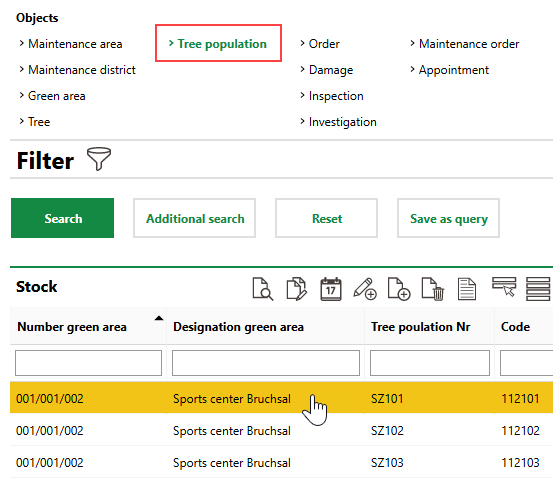
Navigating to a Tree Cluster's Details Page
The tree cluster details page is divided into the sections below.
Tree Cluster
The Tree Cluster section stores the tree cluster's basic high-level details.
Tree Cluster Details
Field |
Description |
||||||
|---|---|---|---|---|---|---|---|
Tree cluster Nr |
A serial number or string to identify the tree cluster by. |
||||||
Green area |
The green area in which the tree cluster is located. |
||||||
Inspection interval |
How frequently the tree cluster should be inspected. Selectable options are saved in the Inspection Interval catalog. The value of this property is overwritten by any interval you select in the New Inspection Interval menu when you complete an inspection for the tree cluster. |
||||||
Quantity |
The number of individual trees in the tree cluster. |
||||||
Code |
A serial number or string assigned to the tree cluster internally. Values in this field are often populated using configurations in the Number Ranges administration. |
||||||
Stage of development |
The tree cluster's stage of development. Selectable options are saved in the Stage of Development catalog. This field inherits the value selected in the Stage of Development field in the most recently completed inspection for the tree cluster. |
||||||
Vitality |
A description of the tree cluster's vital status. Selectable options are saved in the Vitality catalog. This field inherits the value selected in the Vitality field in the most recently completed inspection for the tree cluster. |
||||||
Located |
Whether the tree cluster has corresponding GIS features on an integrated web map. |
||||||
Tree species |
Individual species included in the tree cluster. Refer to Tree Species. |
||||||
State |
The current state of the tree cluster. This value is determined by the option selected in the State menu in the tree cluster's most recent inspection. You can also update the tree cluster's status to Cut by selecting a date in the Cut On field and saving the tree cluster.
|
Basic Data
Field |
Description |
|---|---|
Estimated date of planting |
Whether the date selected in the Average Plant Date field is an estimate. |
Average plant date |
An approximate date the trees in the tree cluster were planted. |
Mean age at time of planting [years] |
The average age of the trees in the tree cluster when they were planted. |
Middle age |
The median age of the trees in the tree cluster. |
Cut on |
The date the trees in the tree cluster were cut. Selecting a date in this field and saving the form when you edit the tree cluster updates the tree cluster's State to Cut. Refer to Cut and Replace Tree Clusters. |
Replacement planting for |
The tree or tree cluster that this tree cluster replaced. You can select existing tree clusters whose State in Cut in this field. |
Coordinate system |
The system in which the tree cluster's coordinates are expressed (for example, WGS 84 or Gauss-Krüger). Selectable options are saved in the Coordinate System catalog. |
X / Longitude |
The x-coordinate (longitude) of the tree cluster's location. |
Y / Latitude |
The y-coordinate (latitude) of the tree cluster's location. |
Country |
The country in which the tree cluster is located. Selectable options are activated in the Country Management administration. |
Street |
The street on which the tree cluster is located. |
House number |
The street address of the tree cluster's location. |
Zip Code |
The ZIP or postal code of the tree cluster. |
City |
The city in which the tree cluster is located. |
District |
The district, state, or province in which the tree cluster is located. |
Accomplishment class |
|
Shape of crown |
The shape of the tree cluster's crown. Selectable options are stored in the Shape of Crown catalog. |
Legal status |
The tree cluster's legal status. Selectable options are saved in the Legal Status catalog. |
Location function |
A descriptor for the tree cluster's specific location. Selectable options are saved in the Location Functional catalog. This field inherits the value selected in the Location Function field in the most recently completed inspection for the tree cluster. |
Security expectation traffic |
The expected level of public circulation near the tree cluster. Selectable options are saved in the Security Expectation Traffic catalog. This field inherits the value selected in the Security Expectation Traffic field in the most recently completed inspection for the tree cluster. |
Cadastral district |
The cadastral district in which the tree cluster's land parcel is located. |
Number of land parcel |
Refer to Land Parcels. |
Real estate |
The real estate on which the tree cluster is located. You can select a real estate saved in the system administration if your license does not include VertiGIS FM Buildings. |
Owner |
The owner of the tree cluster. You must select a contact or company stored in the Contact Management module. |
Contact person |
A point of contact for the tree cluster. You must select a contact or company stored in the Contact Management module. |
Access |
A description of the tree cluster's accessibility to the public. Selectable options are saved in the Access catalog. |
Initial registration by |
The VertiGIS FM user who created the tree cluster. |
Initial registration date * |
The date the tree cluster was created in VertiGIS FM. |
Navigation
The Navigation section shows the tree cluster's place in its VertiGIS FM Greenspaces hierarchy. This includes the maintenance district in which the tree cluster is located, the maintenance area in which the maintenance district is located, and the green area in which the tree cluster is located.
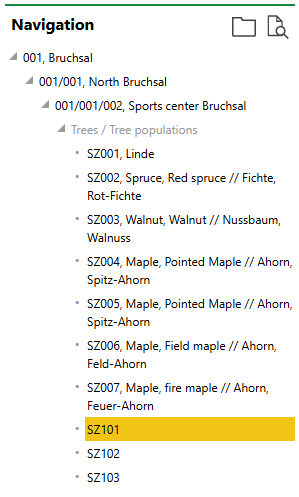
Navigation Section
You can double-click an asset or location in the Navigation section to navigate to its details page.
Tree Species
The Tree Species section lists the individual species included in the tree cluster. You can add and remove species in this section when you edit the tree cluster.
You can add multiple entries for each tree in the tree cluster and specify the share of each species within the tree cluster. A tree cluster with 3 cherry trees and 2 maple trees could look like this:
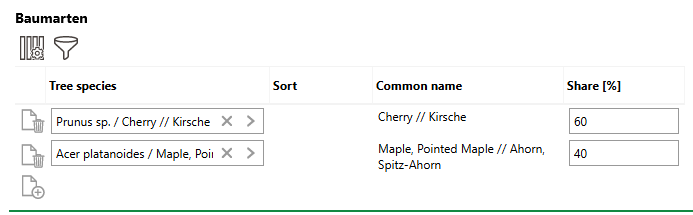
Tree Species for Tree Cluster Including Cherry and Maple Trees
You can click the Add ( ) icon to add additional species included in the tree cluster, or click the Delete (
 ) icon next to the species you want to remove from the tree cluster. Selectable options are saved in the Tree Species catalog.
Current Tree Cluster Data
Data in the Current Tree Data section is inherited from the most recently completed tree cluster inspection. There is no data in this section if no inspections have been completed for the tree cluster.
You can click the Add Tree Data () icon to enter relevant tree cluster data in this section without completing an inspection.
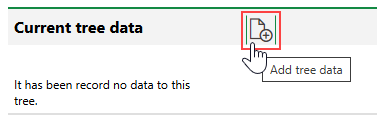
Add Tree Cluster Data
If there is already data in this section, the only way to update it is to complete an inspection.
Current Tree Data
Field |
Description |
|---|---|
Average cluster height |
The average height of trees in the tree cluster. |
Mean treetop diameter |
The mean (i.e., average) crown diameter of trees in the tree cluster. |
Mean treetop height [m] |
The mean (i.e., average) crown height of trees in the tree cluster. |
Mean trunk circumference [cm] |
The mean (i.e., average) circumference of trees in the tree cluster. |
Sub planting |
The tree cluster's sub-irrigation planting system, as determined by the most recent inspection of the tree cluster. |
Vitality |
A description of the tree cluster's vitality, as determined by the most recent inspection of the tree cluster. |
Entry Date |
The date the most recent inspection of tree cluster was completed (i.e., the Executed On date recorded in the inspection), or the date the data was otherwise entered. |
Typist |
The user who completed the most recent inspection of the tree cluster. |
Maintenance Orders
The Maintenance Orders section lists any past and upcoming orders created for the tree cluster.
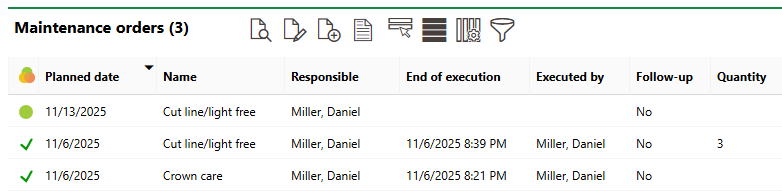
Maintenance Orders Section
For tree clusters, all maintenance orders are manually created and assigned. Refer to Create and Complete Orders for Trees and Tree Clusters for more information.
Refer to Manage Orders, Inspections, and Investigations to understand the differences between the three in tree cluster management.
Inspections
The Inventory Audit section lists any past and upcoming inspections for the tree cluster.

Inventory Audit Section
Inspections with the "Norm Inspection" Name property are system-generated and scheduled for all tree clusters in the database. Inspections marked "Additional Inspection" are manually created for the tree cluster. Refer to Create and Complete Tree Cluster Inspections for more information.
Land Parcels
The Land Parcels section lists the land parcels on which the tree cluster's green area is located.
Damage History
The Damage History section lists issues with the tree cluster that have been recorded during inspections.
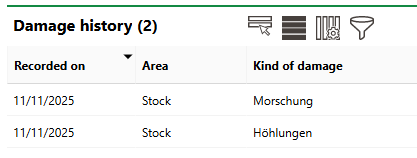
Damage History Section
Refer to Complete Inspections for more information.
Documents
The Documents section lists the documents, including image files, associated with the tree cluster. Refer to Document Management for more information, including instructions on how to upload a document.