Vehicle assets are managed hierarchically, which means all vehicles in your fleet must be organized into multi-level structures. You can add vehicles to a structure that has, at minimum, a class and a type.
Parameters of vehicle management structures vary depending on the size of your fleet and the types of vehicles in it. A vehicle structure can be as few as two levels (a class and a type), but you can add additional levels by contacting support and requesting an advanced database configuration. Criteria for dividing vehicles within the structure can include vehicle types, manufacturers, and models.
For example, in a two-level vehicle structure, you could split vehicles by vehicle type (class) and then by manufacturer (type).
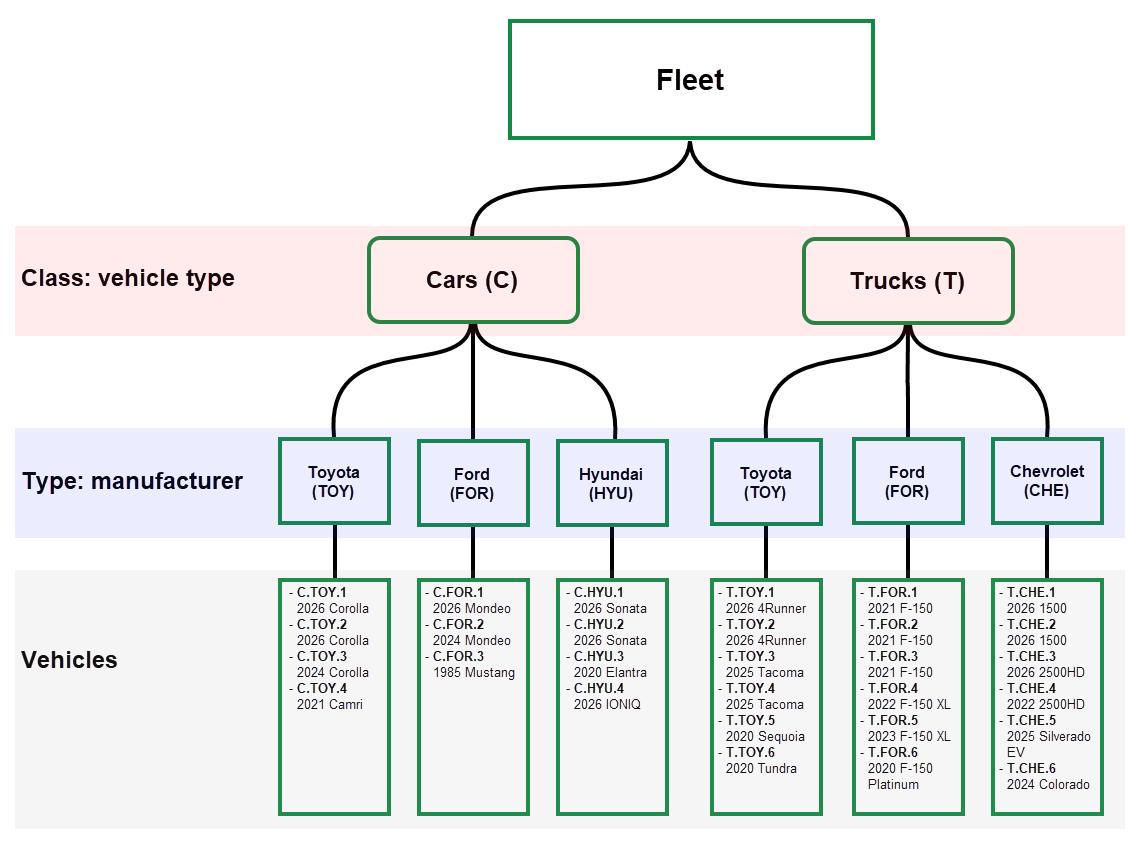
Example Vehicle Structure Sorted by Vehicle Type and Manufacturer
Individual vehicles in your structure each have a unique stock number that reflects the identifying acronyms of the parent type and class. VertiGIS FM differentiates vehicles in the same type group by a decimal number in their stock number, which VertiGIS FM assigns incrementally to each vehicle you add to the class.
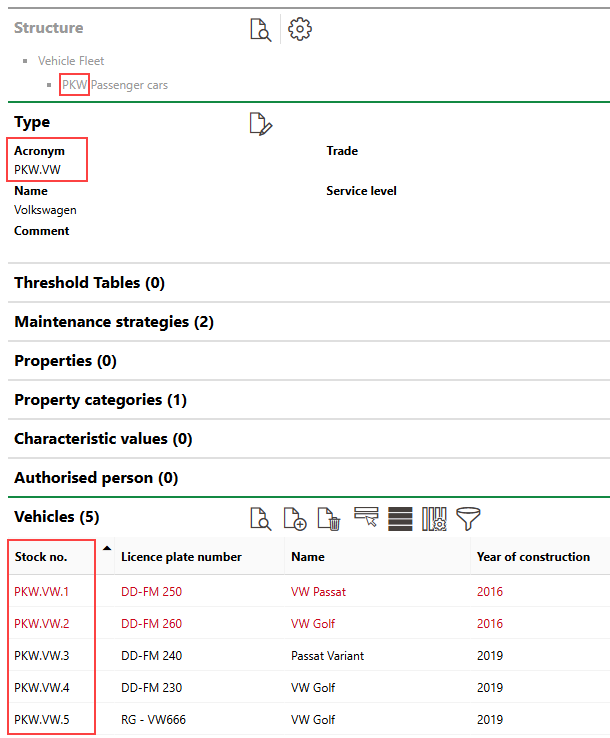
Vehicle Stock Number Reflecting Its Class Acronym, Type Acronym, and Unique Number Identifier
Generally, assigning properties, characteristics, or measurements to a higher node means they are inherited by or made available to the assets below them in the hierarchy.
Refer to Device and Systems Structure, Component Structure, Inventory Structure, and Playground Management Structure for other examples of hierarchical structures used in VertiGIS FM.