Multi-winding Transformers, Three-winding Transformers
Transformers with multiple windings can have more than one winding on the primary or secondary side. The operating principle of the transformer remains the same. Multi-winding transformers can deliver different voltages on the secondary and tertiary sides. The tertiary winding is usually used for the station’s own consumption, and is therefore of limited relevance for network documentation.
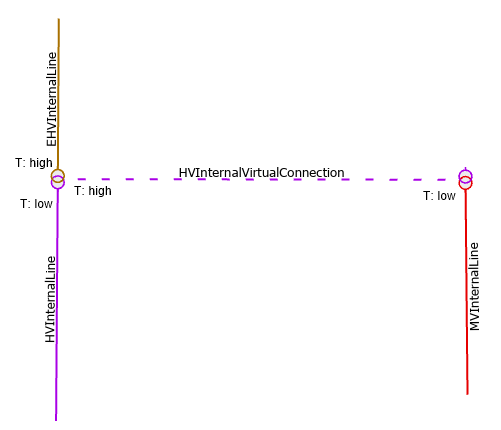
Multi-winding transformers are often used in network levels 2 and 4. Their outputs on the secondary and tertiary sides could serve as subnetwork boundaries for different subnetworks. If this is the case, two parallel transformers must be recorded, representing the same multi-winding transformer. An internal virtual connection links the two transformers.
The attributes AssetName, AssetText, or Remarks can be used to document that it is a multi-winding transformer.
Note:
- The lines must be assigned to the correct terminal (high/low) of the transformer in order for a correct network tracing to be performed.
- In the example above, the secondary side of the EHVHV transformer can be defined as a subnetwork boundary for a high-voltage network. The secondary side of the HVMV transformer serves as the subnetwork boundary for the medium-voltage network; it corresponds to the tertiary side of the multi-winding transformer.